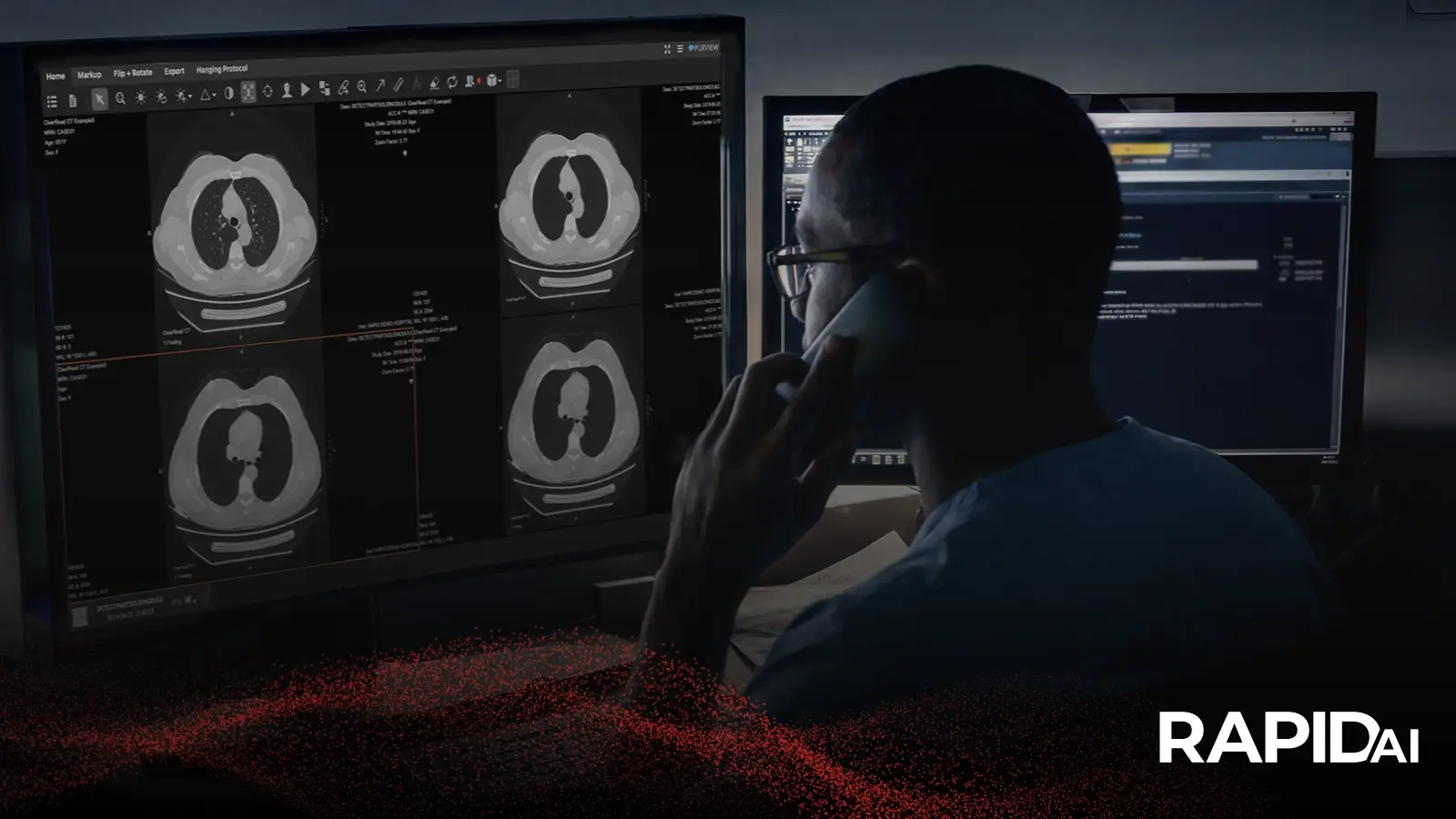

A radiologist moves quickly through a high volume of studies each day, spanning a wide range of anatomic areas and complex disease states. Behind the scenes, each study must be captured and matched to the correct AI models, and the results routed to the right person, often across multiple sites with different scanners, protocols, and configurations. At the same time, some studies or scans need to be prioritized ahead of others given the acute nature of the patient's condition, which requires a very fast response. Today, much of that matching and routing still depends on manual, case-by-case configuration, adding complexity and requiring continuous IT maintenance. That’s the gap we built EdgeIQ to close.
EdgeIQ is a first-of-its-kind intelligent imaging orchestrator and the newest component of the Rapid Enterprise™ Platform.
What EdgeIQ does
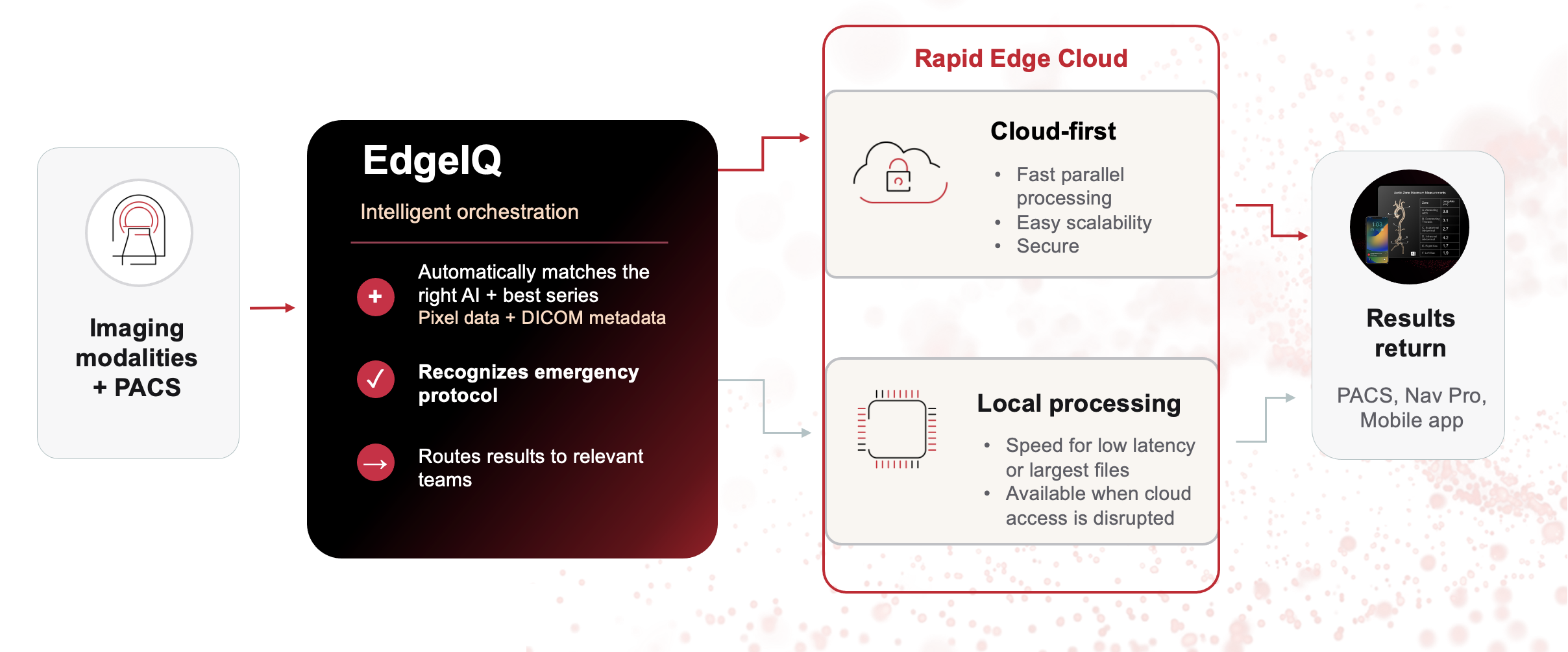
An imaging study is not a single file. It can contain several series, or groups of images, and different AI modules may require different series. Many complex AI algorithms today process not just one series but several series and can produce several outputs. Built on the Rapid Edge Cloud, EdgeIQ uses DICOM metadata and pixel data to identify the relevant series as they become available and sends each one to the appropriate AI module. For acute exams, it also honors the series-prioritization rules already established on the scanner. This allows multiple analyses to begin without waiting for every series in the study to become available.
For health systems running a broad AI portfolio, including third-party algorithms, this provides a consistent and efficient way to identify, process, and prioritize eligible imaging across sites, even when scanners and protocol configurations differ.
The differentiator: intelligence that starts at acquisition
Traditional routing largely functions as a one-time handoff: A completed study is matched to an algorithm for processing. EdgeIQ works continuously from acquisition through processing, coordinating which series go to which AI modules, what should take priority, and when prior imaging should be brought into the workflow. This turns routing into active orchestration that supports urgent analysis, multiple AI workflows in parallel, and more complex comparisons over time.
More complete information for clinical decision-making
Beyond prioritizing studies for AI processing, EdgeIQ works with the Rapid Edge Cloud’s advanced routing capabilities to deliver both positive and negative AI results to care teams. When considered alongside other clinical information, a negative result may help clinicians rule out one suspected condition, narrow the differential diagnosis, and determine the appropriate next step in care.
By ensuring eligible studies are matched with the appropriate AI, EdgeIQ can also help surface findings that might otherwise go undetected, including potential incidental findings on scans performed for another clinical reason. As health systems expand their use of imaging AI, this creates more opportunities for earlier detection and informed follow-up.
EdgeIQ can also automatically retrieve relevant prior studies and direct the appropriate current and prior series into AI workflows designed to assess changes over time. This supports complex longitudinal analysis without requiring teams to manually locate and request earlier imaging.
Speed, scale, and IT efficiency
EdgeIQ uses a distributed architecture to rapidly analyze pixels and DICOM headers on-premises, identify relevant series, and route them to the appropriate cloud-based algorithms. In the cloud, it applies advanced anatomy recognition and robust, algorithm-specific series selection rules. Because imaging studies can often exceed 1 GB, EdgeIQ sends only the data each module requires to the cloud. This reduces unnecessary data transfer, bandwidth use, and cloud storage demands while providing the low-latency performance acute care requires.
As imaging volumes and AI portfolios grow, automated matching reduces dependence on manual protocol mapping, helping limit unprocessed studies and the ongoing maintenance burden on imaging technologists and IT teams. Routing remains configurable, allowing results to be delivered to a specialist, an entire care team, or a customized group based on the health system’s workflow.
Where EdgeIQ fits in the platform
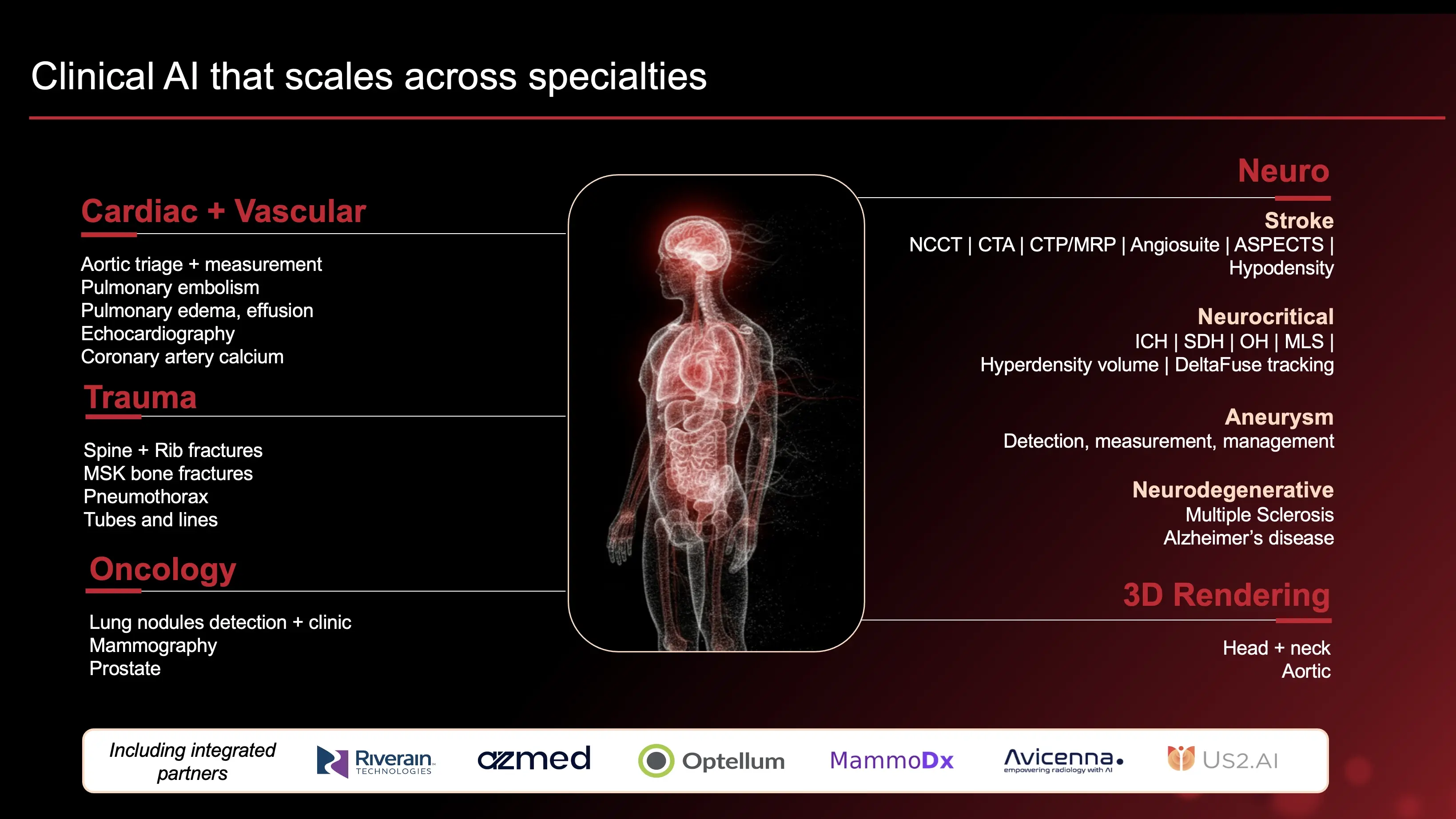
EdgeIQ is the foundational routing infrastructure for the Rapid Enterprise™ Platform. It's the layer that enables deep clinical AI to run consistently at enterprise scale, connecting imaging, patient data, and clinical workflows to ensure the clinical acumen and precision deployed at one site are automatically applied at every site in the system. As we continue to expand what our platform can do, including new capabilities coming to Navigator Pro, EdgeIQ is the routing and prioritization foundation through which all work will run.
EdgeIQ gives health systems a consistent, orchestrated way to match the right study with the right AI, route results and prior scans to the right clinicians, and move the most urgent cases first. That’s the problem EdgeIQ solves and why we see it as critical infrastructure for health systems scaling imaging AI and associated clinical workflows across the enterprise.
Frequently asked questions
What problem was EdgeIQ built to solve?
Health systems generate more imaging than ever, but getting each study to the right AI model and results to the right clinician still depends heavily on manual protocol configuration. That manual work doesn't scale across multiple sites, scanners, and workflows. EdgeIQ automates study and series selection, prioritization, and routing so imaging AI can run consistently across the enterprise.
What is EdgeIQ, in plain terms?
EdgeIQ is RapidAI's intelligent imaging orchestration engine. It automatically identifies what a scan is (the anatomy and scan type) as it comes off the scanner, then routes it to the appropriate AI workflows and to the right people, without a technologist manually setting up protocols for each case.
What role do imaging protocols play in EdgeIQ?
EdgeIQ honors the series-prioritization rules already configured on the scanner, particularly for acute exams. It also independently uses DICOM metadata and pixel data to determine which series each AI module needs, reducing dependence on manual protocol mapping alone.
Is EdgeIQ an "AI orchestration platform"?
Not in the sense that term is often used elsewhere in the industry, where it typically describes a governance layer for deploying and managing many different vendors' algorithms across a health system. EdgeIQ operates a level deeper, at the point of image acquisition, continuously coordinating which studies and series should be processed, which AI modules should process them, and what should take priority.
How is EdgeIQ different from other imaging routing technology?
Traditional routing often treats a completed study as a single unit and sends it to an algorithm. EdgeIQ begins working during acquisition, can send multiple series to one or more AI modules in parallel, honors scanner-based priorities, and automatically brings relevant prior imaging into workflows that assess changes over time.
How does EdgeIQ fit into RapidAI's enterprise platform?
EdgeIQ is the intelligent orchestration layer within the Rapid Enterprise™ Platform. It enables RapidAI and partner AI to operate consistently across sites, connecting image acquisition, AI processing, longitudinal workflows, and results delivery.