
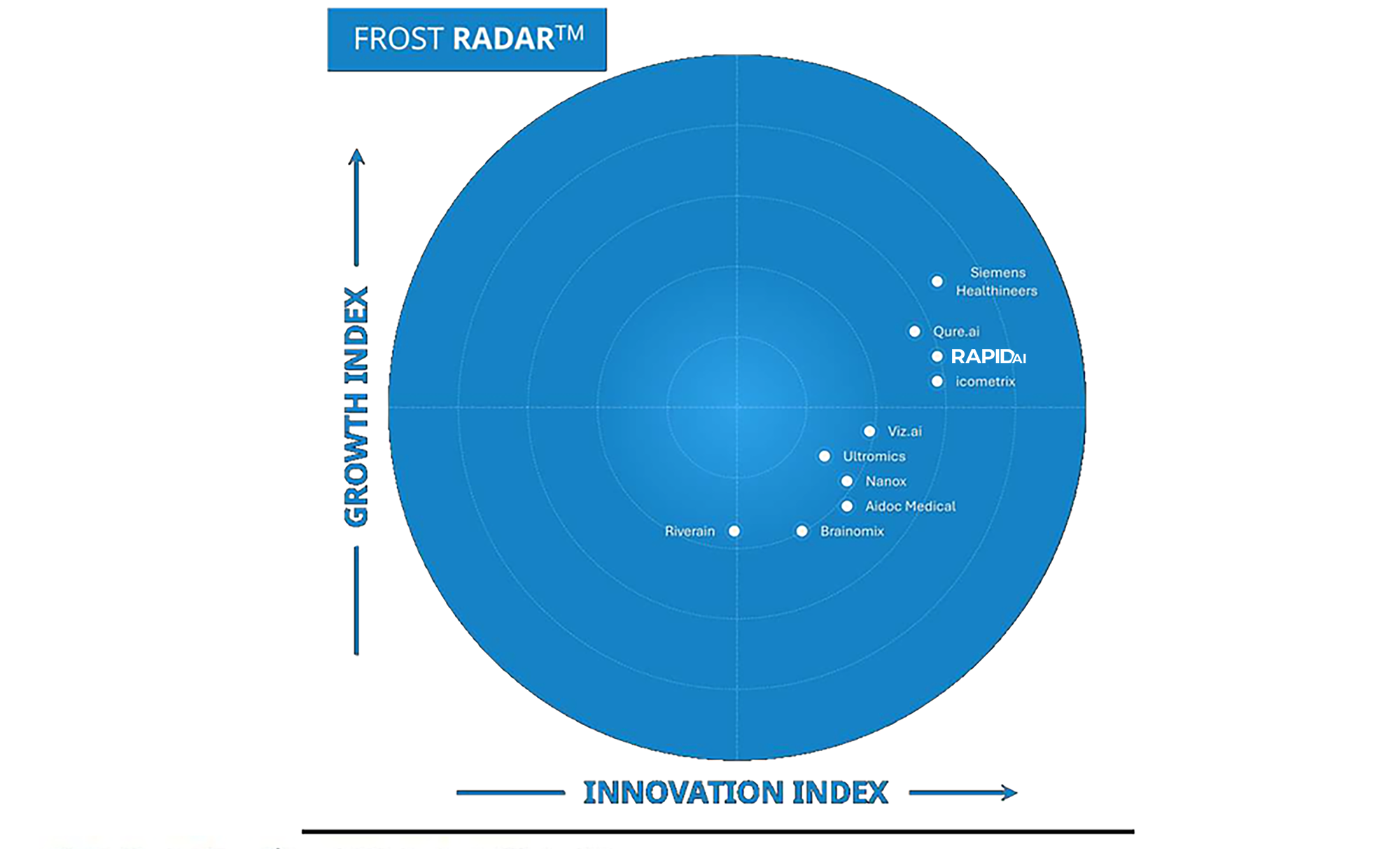
Frost & Sullivan ranked RapidAI among the leaders in its Frost Radar™: Intelligent Imaging Analysis Systems, 2026 — scoring 4.8 out of 5.0 on Innovation. For a report that evaluated both specialized AI companies and some of the largest traditional imaging vendors in healthcare, that placement matters.
But what it reflects about where the market is headed matters even more.
AI in medical imaging is being evaluated differently now
The conversation around AI in medical imaging has fundamentally changed. For years, the industry focused primarily on algorithm performance: Could AI detect abnormalities faster? Could it improve diagnostic accuracy? Could it help overstretched clinical teams manage growing imaging volumes?
Those questions still matter. But healthcare systems are increasingly evaluating imaging AI through a broader operational lens. Today, leaders are asking whether these technologies can scale across the enterprise, integrate into clinical workflows, support coordination across care teams, and improve care delivery under real-world pressure.
Why imaging volumes and staffing pressures are redefining AI requirements
That shift is being driven by necessity. Imaging volumes continue to rise globally while many health systems face staffing shortages, operational fragmentation, and increasing pressure to deliver fast and flawless. In this environment, the value of AI extends far beyond detection support alone.
From imaging insight to clinical action: what enterprise AI actually means
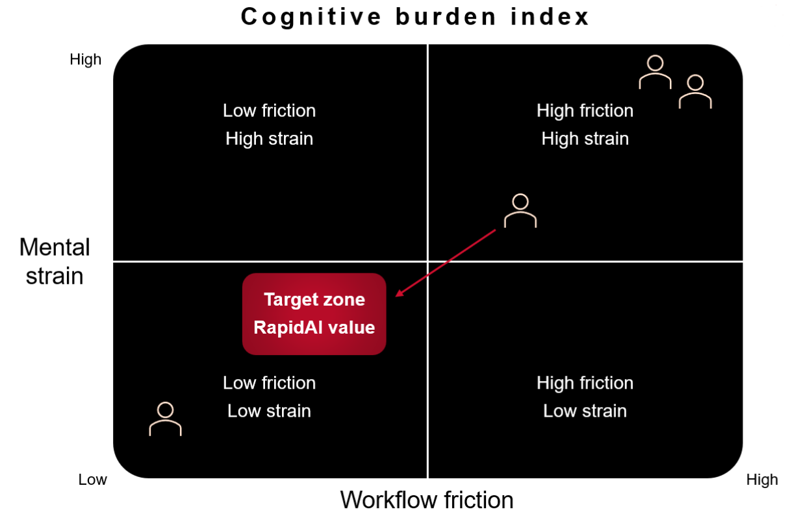
The most impactful platforms help radiologists and clinicians move quickly from imaging insight to clinical action at every step of the patient journey. They reduce friction between departments, improve coordination between specialists, and help healthcare organizations standardize care pathways across sites and service lines.
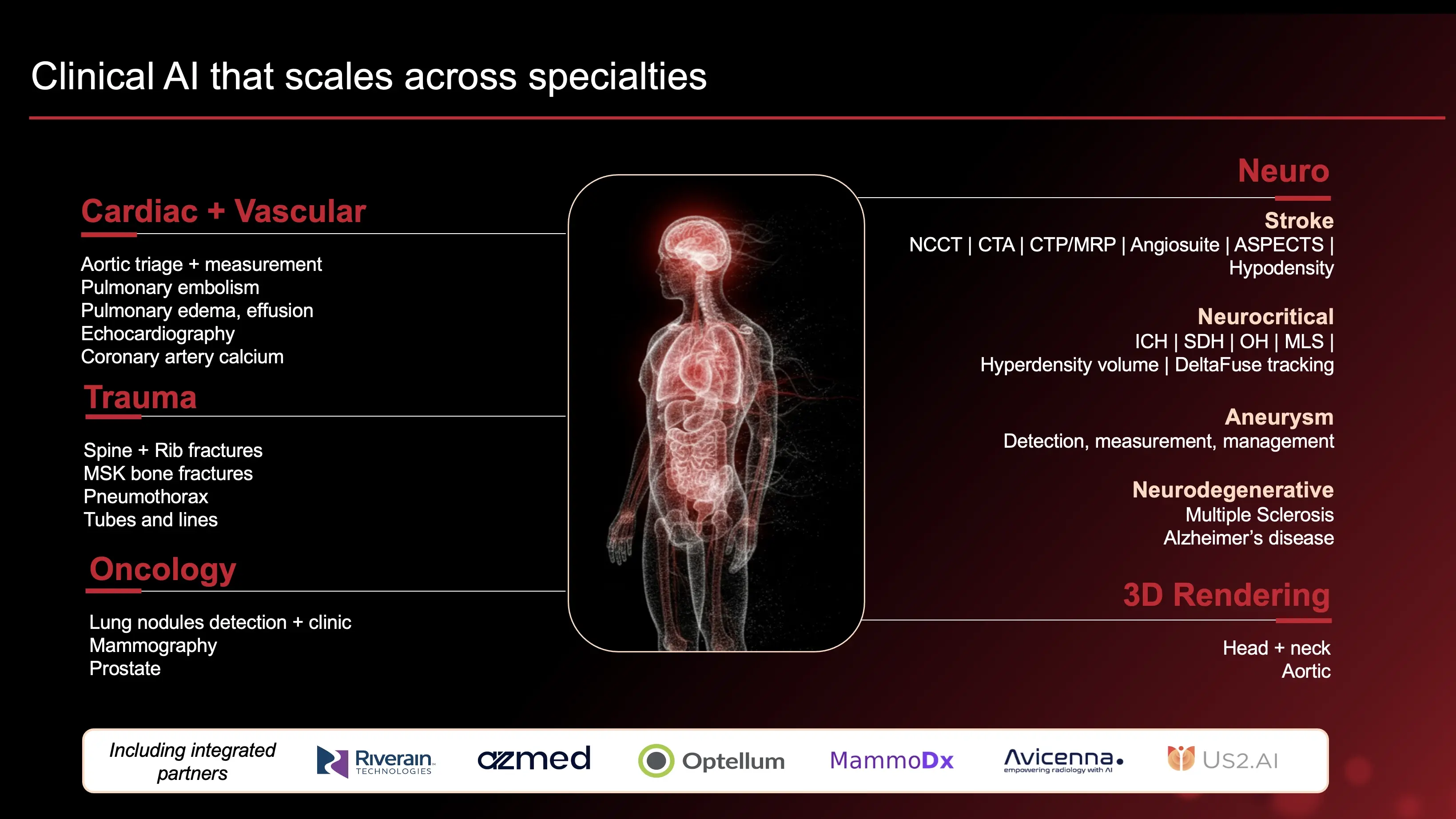
That enterprise-wide approach has shaped RapidAI's strategy from the beginning. Rather than focusing narrowly on standalone detection algorithms, we've built a connected deep clinical AI platform designed to automate imaging insights that are otherwise time-consuming to calculate or difficult to visualize — while improving workflow coordination and operational visibility across the patient journey.
The scale speaks for itself. RapidAI is deployed across more than 2,500 hospitals in over 100 countries, with more than 20k daily scans processed globally and validation across more than 1,000 clinical studies and 750+ peer-reviewed publications. Real-world evidence at that scale is harder to dismiss than any marketing claim.
A true enterprise AI solution requires all algorithms, Rapid and third-party, to be integrated into radiology workflows that prioritize PACS worklists, facilitate reads through advanced viewers, and automate note-taking. Navigator Pro™ is RapidAI's radiology solution built to do exactly that. But the platform doesn't stop at radiology. Connecting those workflows to the broader care team is what reduces friction, improves coordination and follow-through, and ultimately drives better outcomes.
What the Frost & Sullivan 2026 Radar says about where imaging AI is headed
The next generation of imaging AI will push beyond detection toward prediction, prioritization, and connected clinical decision support. Frost & Sullivan points to growing demand for adaptive intelligence, patient stratification, and platforms capable of improving coordination across the continuum of care: a direction RapidAI has been building toward long before it became the industry consensus.
The organizations shaping the future of intelligent imaging won't simply be those with strong algorithms. They'll be the ones that combine deep clinical intelligence, enterprise-scale interoperability, workflow coordination, and measurable operational impact.
That's where the market is headed. And this recognition reflects how far we've already come.
FAQs
What did Frost & Sullivan's 2026 Radar evaluate in intelligent imaging AI?
The Frost & Sullivan assessed more than 50 companies, selecting the top 10 based on Innovation (scalability, IP, disruption potential, deployment readiness) and Growth (application diversity, adoption, partnerships, product pipeline). Only FDA- or CE-cleared software was included.
How is healthcare evaluating AI in medical imaging today?
Health systems have moved beyond evaluating AI on detection accuracy alone. Today, clinical and operational leaders assess whether imaging AI can scale across the enterprise, integrate into existing workflows, support cross-team care coordination, and deliver measurable impact under real-world conditions.
What challenges are driving adoption of enterprise imaging AI platforms?
Rising global imaging volumes, radiologist staffing shortages, operational fragmentation across departments, and pressure to standardize care pathways across hospital sites are all accelerating demand for AI platforms that go beyond standalone detection.
What makes RapidAI different from other imaging AI vendors?
RapidAI is built as a connected clinical AI platform rather than a collection of standalone detection algorithms. It automates imaging insights that are time-consuming to calculate or difficult to visualize, while improving workflow coordination across the full patient journey. It is deployed in 2,500+ hospitals across 100+ countries, with validation across 1,000+ clinical studies and 700+ peer-reviewed publications.
What is the future direction of intelligent imaging AI?
Frost & Sullivan points to growing demand for adaptive intelligence, patient stratification, and platforms that improve coordination across the care continuum. The next generation of imaging AI is expected to move beyond detection toward prediction, prioritization, and connected clinical decision support — a direction RapidAI has been building toward ahead of the broader industry.